9
Tail
Backbone
Secondary
flight feathers
Primary flight
feathers
Hind
toe
Ankle
Tibia
Radius
Femur
Alula
Claw
Cranium
Long
fins
Neck
vertebrae
Eye socket
Humerus
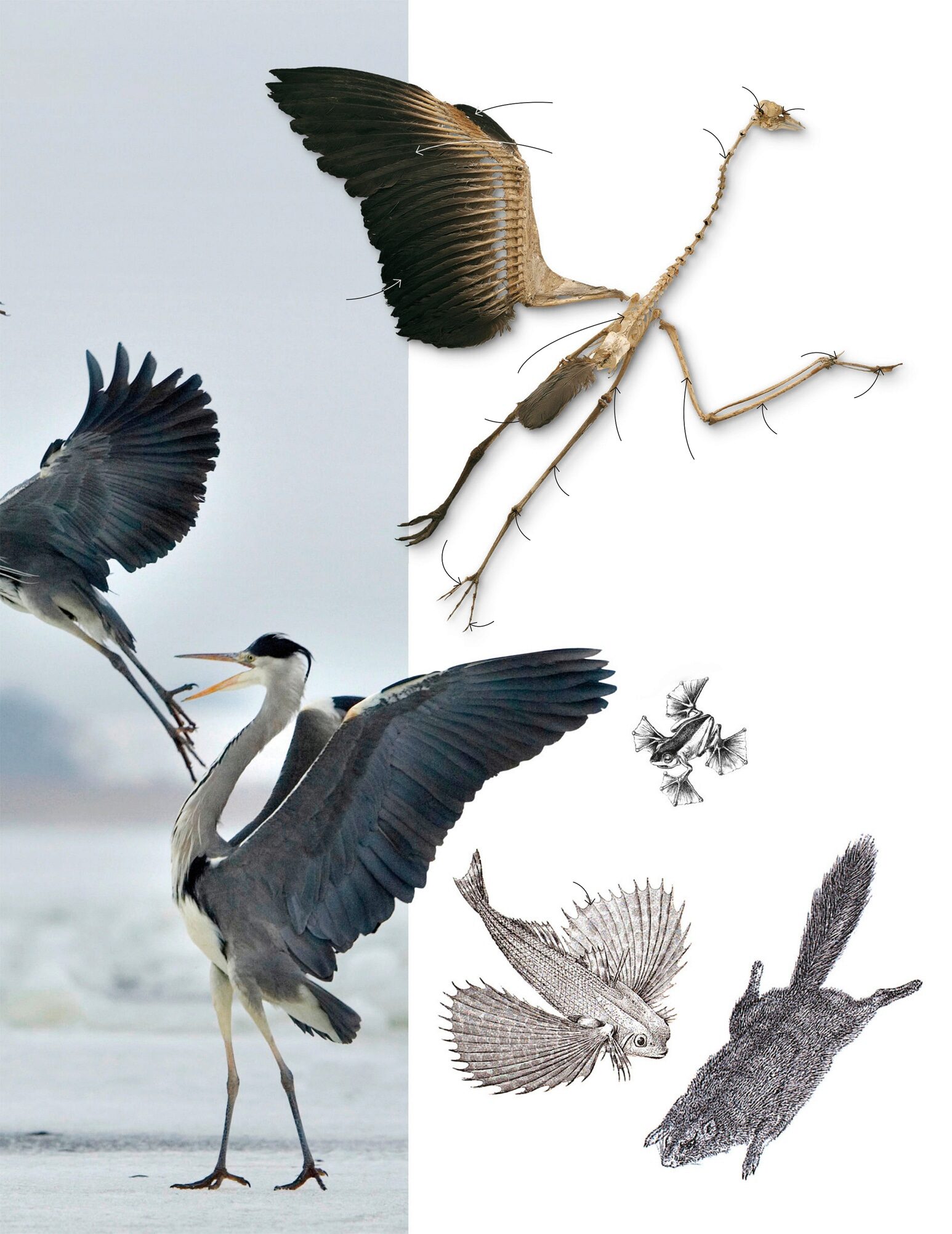
Design for flight
Flight makes enormous
demands on a bird’s body.
Once airborne, a bird like a
heron may save energy by
gliding, but it requires all the
power it can produce for its
initial take-off. As well as having
a lightweight skeleton, birds
have a high metabolic rate –
the speed at which they turn
food into energy, which helps
them to fly.
Long neck
Birds have more
bones in the neck
than most vertebrate
animals. A bird such as a
heron has a flexible neck,
which it uses to catch food
and to preen all parts of its
body with its beak.
Thumb
Finger
Animals that fly
Birds and bats are the only vertebrate
animals capable of true powered flight.
Some other animals are able to glide
on unpowered “wings”.
Flying fish
The gurnard can glide
above the water on
extended fins.
Flying squirrels
Some squirrels use loose
flaps of skin to glide
through the air.
Flying frogs
The webbing between
the frog’s feet act
like miniature
parachutes to
enable it to glide
between trees.